✍︎ Gerielyn D. Saldua
Is corruption a birthmark of our democracy, or have we simply inherited a habit of betrayal that we no longer have the strength to break? From the very first days of our government, history has been stained by leaders who chose personal gain over the people’s trust. This habit of betrayal has survived for so long because it has successfully exhausted the Filipino spirit.
For decades, the Filipino people have been sold the promise of a better system, yet with every passing administration, the rot only seems to settle deeper. We have traded one set of promises for another, only to find that the progress we were promised was nothing more than a façade.
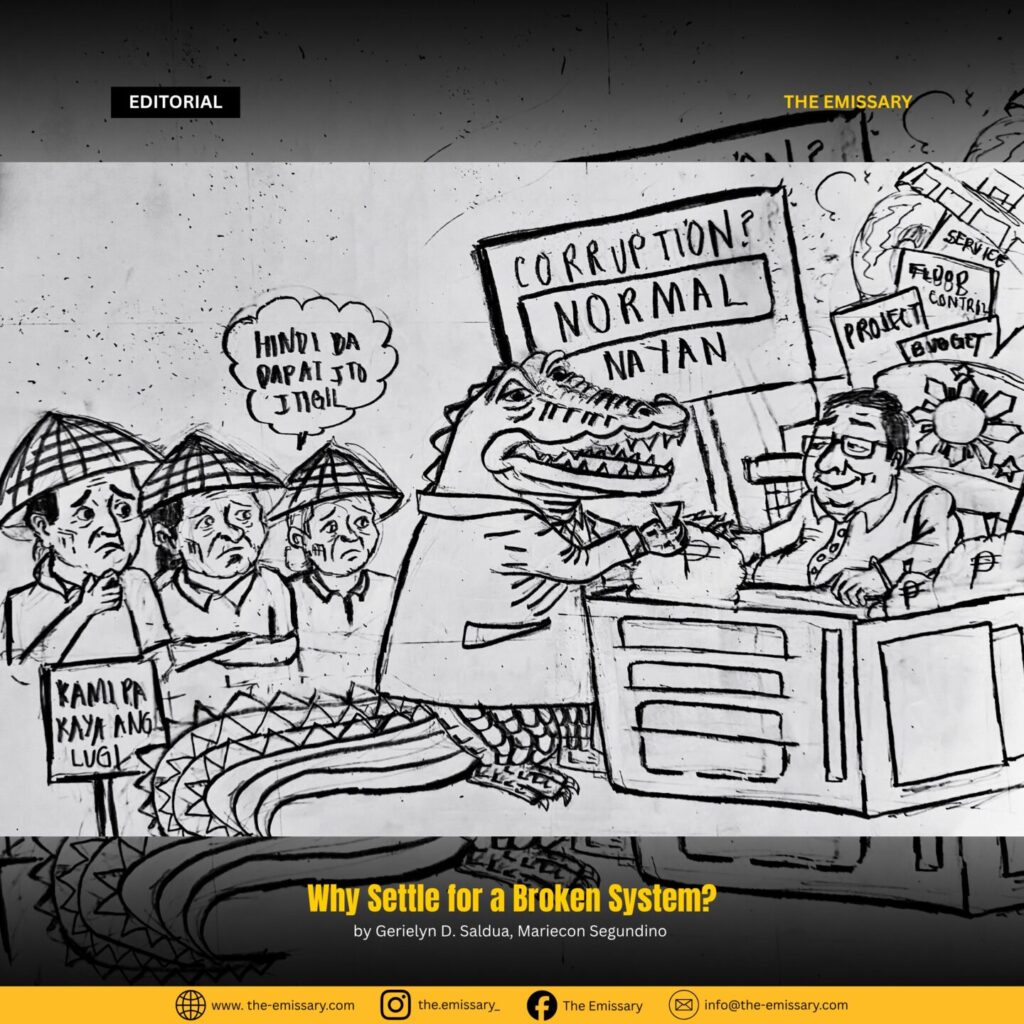
When promises are broken as a matter of routine, corruption stops being an outrage and starts being treated as an atmospheric fact, like the weather or the heavy heat of noon. We have reached a point where many of us no longer ask if a leader is corrupt, but how much. We accept small, daily favors because we have been conditioned to believe that a clean path is a fairy tale—and in a world of crocodiles, one must learn to swim in murky water just to survive.
For a long time, the government has promised better roads and bridges that would protect us from the floods we face every year. Billions of pesos have been poured into these projects, yet the public rarely knows where that money goes—until nature itself exposes the truth. It is only when typhoons strike, when people lose their homes, and when the death toll rises that our leaders begin to speak. Their anger is loud, but it is too late. The water has already destroyed everything that hardworking Filipinos spent their whole lives building. We are left to realize that the protection promised to us was nothing more than a lie that washed away with the first rain.
We are taught to be resilient, but why must we be resilient against the very people who are supposed to protect us?
The disparity in our justice system is as murky as the floodwaters we wade through. In this country, a common citizen who steals out of desperation is met with the full, immediate force of the law. Yet the crocodiles who drain billions from the kaban ng bayan—the literal sweat and blood of hardworking Filipinos—remain free to travel the world and retreat into their mansions. They sit in the very halls of power they have betrayed, comfortably quoting Rizal’s words, “Mga kabataan ang pag-asa ng bayan,” while simultaneously dismantling the future of that same youth for their personal gain. It is a bitter irony: those meant to build our foundation are the ones selling the bricks for profit.
Today, the cry of the Filipino is a desperate chorus of questions: “Bakit wala pang nakukulong?” “Nasaan ang pera ng bayan?” “Kailan namin makakamit ang hustisya?” Yet the government remains deaf.
Why is it that the most expensive things in our country are the services that are supposed to be free? Today, the domino effect of global oil prices has made every meal a struggle, yet our leaders seem more concerned with unnecessary matters than with the hunger in our streets. We are a country rich in resources, yet we are a people starving for integrity. We suffer not because of a lack of wealth, but because of a surplus of greed from the leaders we once trusted to be our shepherds.
Because of corruption, millions of Filipinos are pushed deeper into hardship. It is the public being robbed, so it is only right that the public holds the wrongdoers accountable. We must open our eyes to the truth. Corruption may seem like an incurable disease, but we can still stop it from spreading. We must use our right to vote with wisdom and care. Let us not waste our ballots on politicians who have already stained their names with corruption.
We must be brave enough to report the wrongdoing we see in our government. That stolen money belongs to us, and it is our duty to protect it. Let us join the fight, choose right over wrong, and refuse to be tools that allow this plague to win. Corruption should never be accepted or tolerated.
Illustration: Mariecon Segundino