✍︎ Caryl Jane R. Ordeñiza
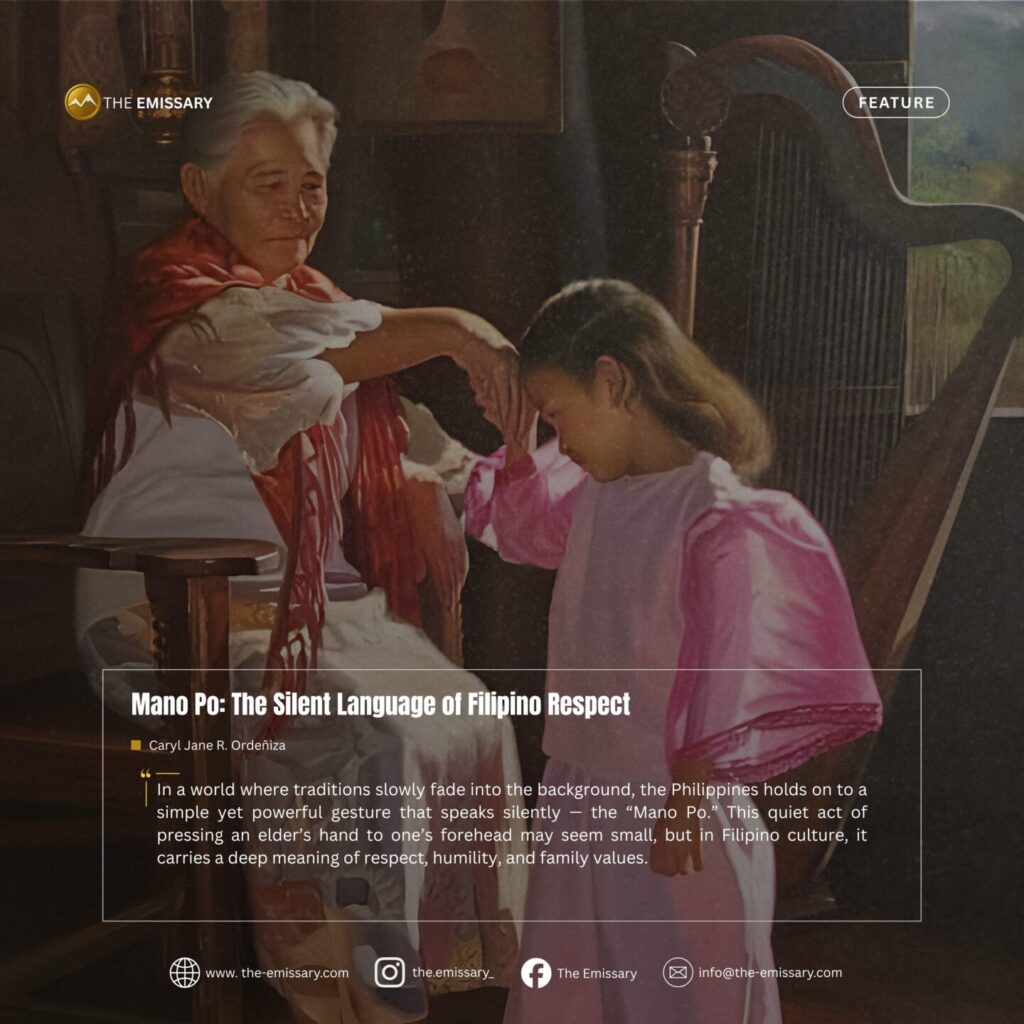
In a world where traditions slowly fade into the background, the Philippines holds on to a simple yet powerful gesture that speaks silently — the “Mano Po.” This quiet act of pressing an elder’s hand to one’s forehead may seem small, but in Filipino culture, it carries a deep meaning of respect, humility, and family values.
The word “mano” is a Spanish term for “hand,” while “po” is a Filipino expression used at the end of sentences as a sign of respect when addressing someone older. Put together, “mano po” literally translates to “your hand, please.” The gesture is simple: a younger person approaches an elder, who often extends their right hand, which the younger person then gently lifts to touch the back of the hand to their forehead. This act is usually done while saying “Mano po,” or sometimes just “Bless.”
This gesture is both a request for a blessing and a way of showing deep respect. It is typically practiced when greeting older family members or respected figures, especially during visits or reunions. The act may be quiet and simple, but its meaning is loud and clear — honoring those who came before us.
In many Filipino homes, children are taught this practice from an early age. During family gatherings, it is common to see young ones approaching grandparents, aunts, and uncles with outstretched hands, even if they are timid or shy. The elders, in turn, often respond with a smile, a gentle blessing, or a short prayer such as “God bless you” or “Mag-ingat ka palagi.” This exchange reflects not only respect but also the deep intergenerational bonds that form the foundation of Filipino families.
Today, as the world grows more fast-paced and individualistic, some worry that traditions like “Mano Po” may slowly vanish. However, many schools, churches, and families continue to teach and encourage it, knowing that such a small act carries the weight of centuries. Performing the gesture is not just about the motion itself — it’s about connection, respect, and cultural pride.
In a time when voices are loud and attention is fleeting, the silent language of “Mano Po” reminds us that sometimes, the most powerful messages are those spoken not with words, but with the heart.
References
Mano or pagmamano – an “honoring gesture” in Filipino culture. (n.d.). The Voice of Vietnam. https://vovworld.vn/en-US/culture-rendezvous/mano-or-pagmamano-an-honoring-gesture-in-filipino-culture-800534.vov#&gid=1&pid=2
Gutierrez, R. M. (2024, June 3). Understanding Mano Po in Filipino society. World Mission. https://worldmissionmagazine.com/understanding-mano-po-in-filipino-society/
Mano Po Archives – Philippine Nikkei Jin Kai, Incorporated. (n.d.). Philippine Nikkei Jin Kai, Incorporated. https://pnjkincdavao.com/tag/mano-po/