✍︎ Czarhytha Ais Omaguing
“Guys, can you send your parts tonight?”
Seen. No reply.
Minutes turn into hours. Hours turn into midnight. The typing bubble never appears, yet the deadline continues to crawl closer—unforgiving and impatient.
Then suddenly, a message arrives.
“Sorry, busy.”
Attached beneath it is a rushed paragraph filled with copied lines, unfinished thoughts, and careless errors—work that clearly took five minutes to make but will take another hour to fix.
And somehow, the responsibility silently falls back onto the same person again.
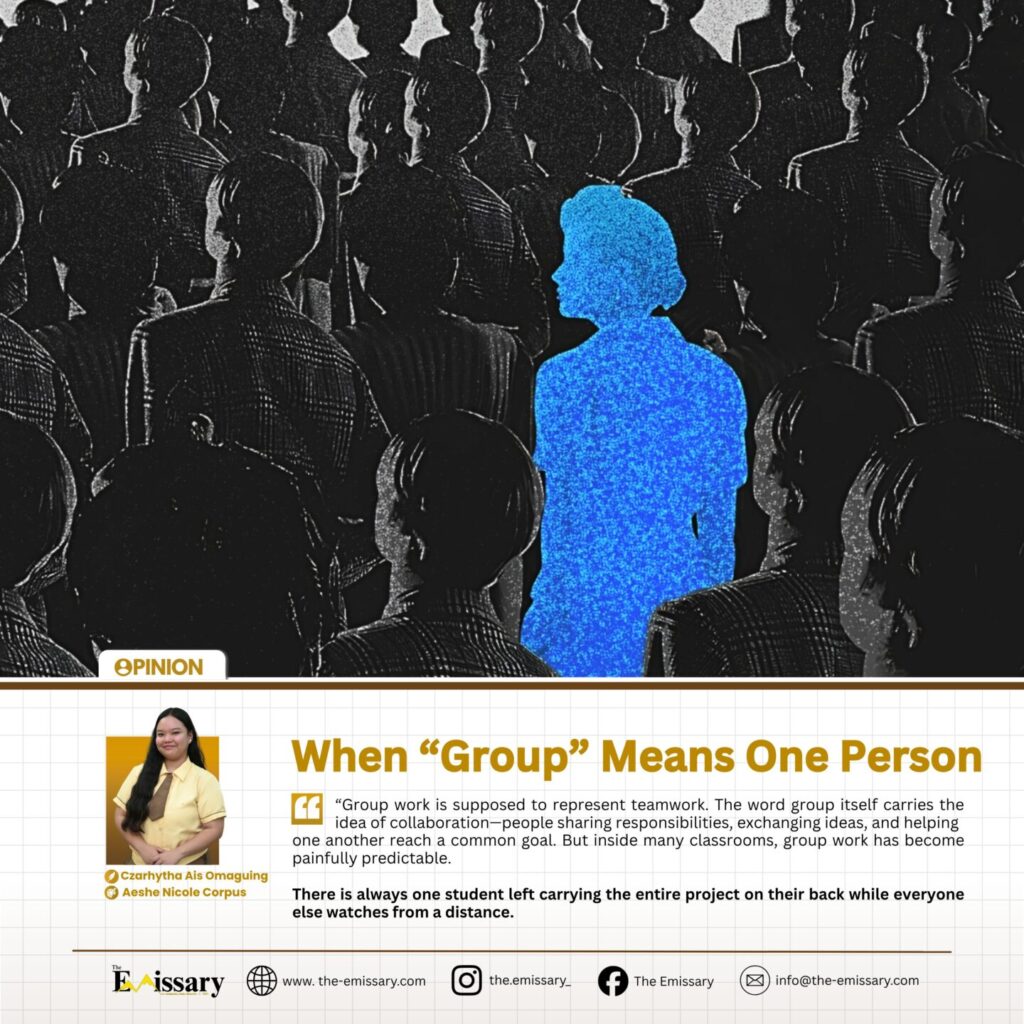
Group work is supposed to represent teamwork. The word group itself carries the idea of collaboration—people sharing responsibilities, exchanging ideas, and helping one another reach a common goal. But inside many classrooms, group work has become painfully predictable.
There is always one student left carrying the entire project on their back while everyone else watches from a distance.
That student becomes everything at once: the leader, the planner, the researcher, the editor, the reminder alarm, and sometimes even the emotional punching bag of the group. They are the ones staying awake at two in the morning, rearranging poorly made slides, rewriting incorrect answers, and fixing missing outputs because nobody else cared enough to do their part properly.
What makes it exhausting is not even the project itself.
Most school activities can actually be finished alone. The real burden comes from the unfairness of it all—the feeling that while you are sacrificing sleep, juggling deadlines, and pressuring yourself to save the group’s grade, others are peacefully offline, unconcerned because they know someone else will eventually do the work for them.
The most frustrating part is how normalized this setup has become. Students laugh about “the one who carries the group” as if it were simply part of school culture. But behind those jokes are students silently burning themselves out just to keep everything from falling apart.
And when groupmates finally contribute, it often feels half-hearted—unfinished sentences, copied information, random designs, or outputs submitted minutes before the deadline. Instead of lessening the workload, these contributions create even more stress because someone still has to revise and fix everything.
In the end, the project gets submitted, the presentation ends, and everyone receives the same grade. Yet behind that finished output is one exhausted student whose sleepless nights, sacrificed time, and unseen effort are never truly acknowledged—only silently expected again in the next “group work.”