✍︎ Ma. Niña Carmel Candar
In the halls of Washington and across the breakfast tables of America, a subtle linguistic battle is being waged. It’s a conflict not of missiles or sanctions, but of phonemes. Depending on who is speaking, the nation in the heart of the Middle East is either “Ih-RAN” (rhyming with ran) or “Ee-RON” (rhyming with gone).
To the casual listener, it sounds like a simple regional accent or a slip of the tongue. But according to linguists and political scientists, how you say the word “Iran” serves as a vocal shibboleth—a verbal password that broadcasts your political leanings, your level of empathy, and your stance on global intervention.
As noted in a recent analysis by The Conversation, the way we pronounce foreign place names is rarely accidental. In the United States, the “Eye-RAN” or “Ih-RAN” pronunciation (using the “short-a” vowel) has long been associated with a more hawkish, anglicized approach to foreign policy. Conversely, the “Ee-RON” or “Ih-RON” pronunciation (using the “broad-a”) is often seen as an attempt to mimic the native Farsi pronunciation, signaling a level of cultural respect or diplomatic nuance.
This isn’t just a theory; it follows a pattern established during the Iraq War. Studies of political discourse found that conservative politicians were significantly more likely to use the anglicized “Eye-RACK,” while liberal-leaning figures opted for “Ee-ROCK.” This “linguistic signaling” suggests that the flatter, more Americanized vowel serves to domesticate the “other,” framing the country through a Western lens rather than its own native identity
The weight of the name “Iran” is also rooted in a deliberate historical shift. Until 1935, the Western world knew the country as Persia. The change was not a natural evolution but a request from Reza Shah Pahlavi, who asked foreign diplomats to use “Iran”—the name used by its own people for centuries—to signify a new era of modernization and national pride.
By choosing “Iran” (which translates to “Land of the Aryans”), the Shah sought to shed the colonial baggage associated with “Persia” and reclaim a sense of ancient history. When we mispronounce that name today, we aren’t just getting a word wrong; we are, in a sense, pushing back against that reclamation of identity.
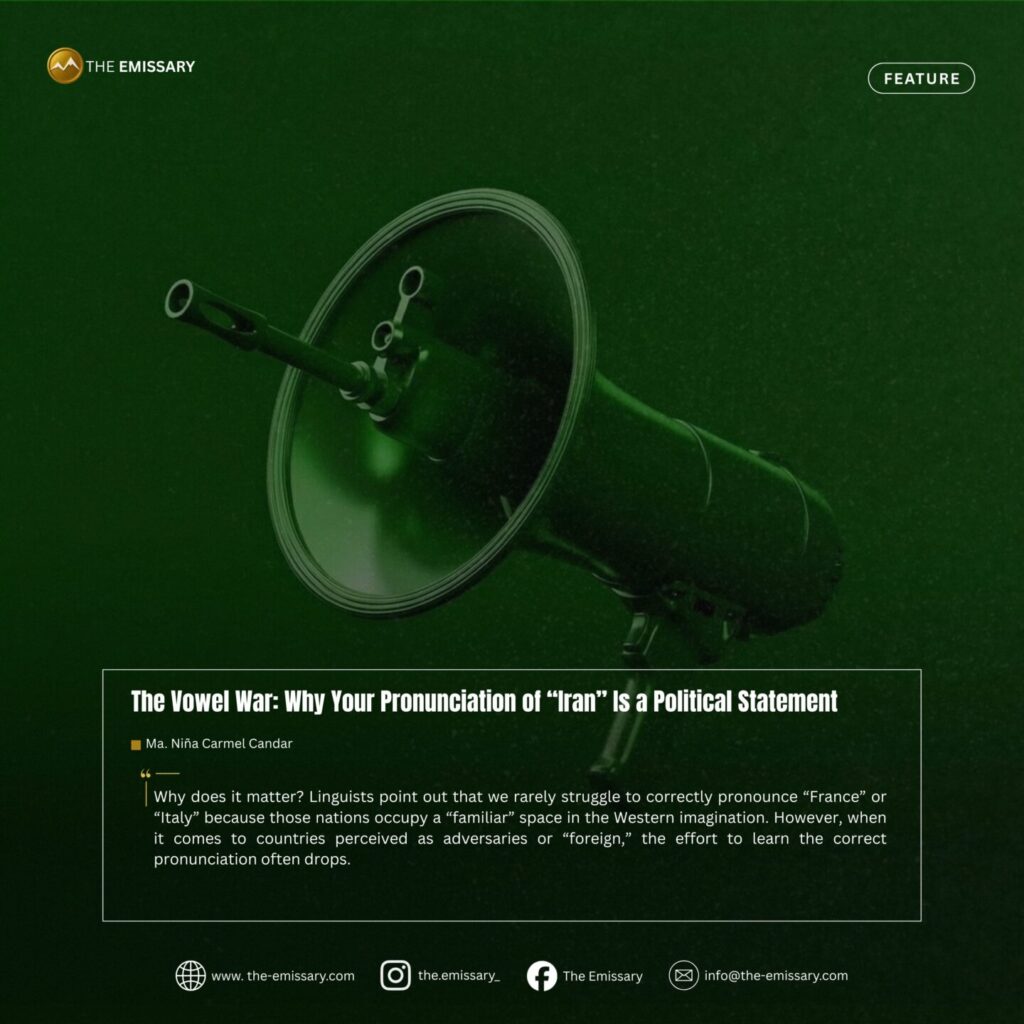
Why does it matter? Linguists point out that we rarely struggle to correctly pronounce “France” or “Italy” because those nations occupy a “familiar” space in the Western imagination. However, when it comes to countries perceived as adversaries or “foreign,” the effort to learn the correct pronunciation often drops.
Choosing the native-approximate “Ee-RON” is seen by many as an act of “linguistic hospitality.” On the flip side, as The Conversation highlights, figures like Donald Trump and JD Vance have frequently used the “Ih-RAN” pronunciation. In the high-stakes world of international relations, this “hard” pronunciation can act as a rhetorical tool—a way of signaling “America First” by refusing to adapt to foreign linguistic norms.
Language is our most powerful tool for humanizing or dehumanizing those across the globe. While a single vowel may seem trivial, it carries the weight of history, the shadow of colonialism, and the map of our political divides. The next time you hear “Iran” on the news, listen closely: you aren’t just hearing a name—you’re hearing a worldview.
References: