✍︎ Gerielyn D. Saldua
Since 1578, the royal chapel of the Cathedral of San Giovanni Battista in Turin, Italy, has preserved an artifact that sits at the uneasy intersection where laboratory data meets ancient devotion. Imagine an image that exists without paint, without ink, and without a single brushstroke. It is a portrait etched into ancient linen—a negative image that has baffled the greatest medical minds and scientific laboratories for decades. This is the Shroud of Turin. It isn’t just one of the most studied items in history—it is arguably the most studied. Despite the advancements of 2026, the question remains: How did the image get there? For many, this mystery is not just about history—it is also about evidence of the unseen.
As we approach Good Friday, the shroud inevitably returns to the center of global conversation. Yet the question of how it arrived in Italy remains a historical enigma. To understand the weight of the mystery, one must look at its current standing. According to Encyclopedia Britannica, the Shroud of Turin is a length of linen purported to be the burial garment of Jesus Christ, preserved since 1578 in its current home in Turin, Italy. For centuries, the Shroud has been the focus of debates regarding its authenticity, serving simultaneously as a lightning rod for scientific scrutiny and a profound object of devotion for those who believe it is a true relic of Christ.
While the shroud is a matter of faith for many, its documented history is a matter of established record. As noted by Encyclopedia Britannica, the cloth’s known journey began in 1354, when it was recorded in the possession of the knight Geoffroi de Charnay. There is no surviving record of how he obtained it, and its early public life was immediately met with controversy. In 1389, the local bishop of Troyes denounced the Shroud as a fraud, claiming it was a clever painting and even citing an artist who allegedly admitted to creating it. During this time, the Avignon antipope Clement VII remained neutral on its authenticity, allowing it to be displayed only as a “representation” of the true burial cloth rather than the original relic.
However, the Shroud’s status changed significantly in the following centuries as subsequent popes began to accept it as authentic. In 1453, the cloth was transferred to the House of Savoy, where it survived a damaging fire in 1532 before being moved to its permanent home in Turin in 1578. Since that move, the Shroud has been guarded in the Cathedral of San Giovanni Battista and exhibited only on rare, special occasions. In the modern era, the cloth has moved beyond mere historical debate to become what Pope John Paul II called “a mirror of the Gospel.” Through the twentieth and twenty-first centuries, it has continued to serve as a powerful symbol of devotion, drawing millions of pilgrims, including Pope Benedict XVI and Pope Francis, who view the linen not just as an artifact, but as a profound icon of the Passion.
The historical debate eventually paved the way for intense scientific inquiry, most notably in 1978, when the Shroud of Turin Research Project (STURP) was granted 120 hours of direct access to the cloth. This team, composed of roughly 30 world-class scientists from institutions such as NASA’s Jet Propulsion Laboratory and Los Alamos National Laboratory, arrived in Italy with tons of advanced equipment to perform non-destructive testing. After years of analyzing the data, the STURP team’s final report concluded that the image was not the product of an artist. They found no traces of pigments, dyes, or brushstrokes and famously stated that the image is that of a real human form—a scourged, crucified man.
Perhaps most significantly, the researchers discovered that the image is purely superficial, affecting only the topmost fibers of the linen, and contains unique three-dimensional information that cannot be replicated by any known photographic or artistic technique. While the 1988 carbon dating later suggested a medieval origin, the physical and chemical anomalies identified by the STURP researchers continue to be the primary evidence for those who believe the cloth is a miraculous acheiropoietos, or an image not made by human hands.
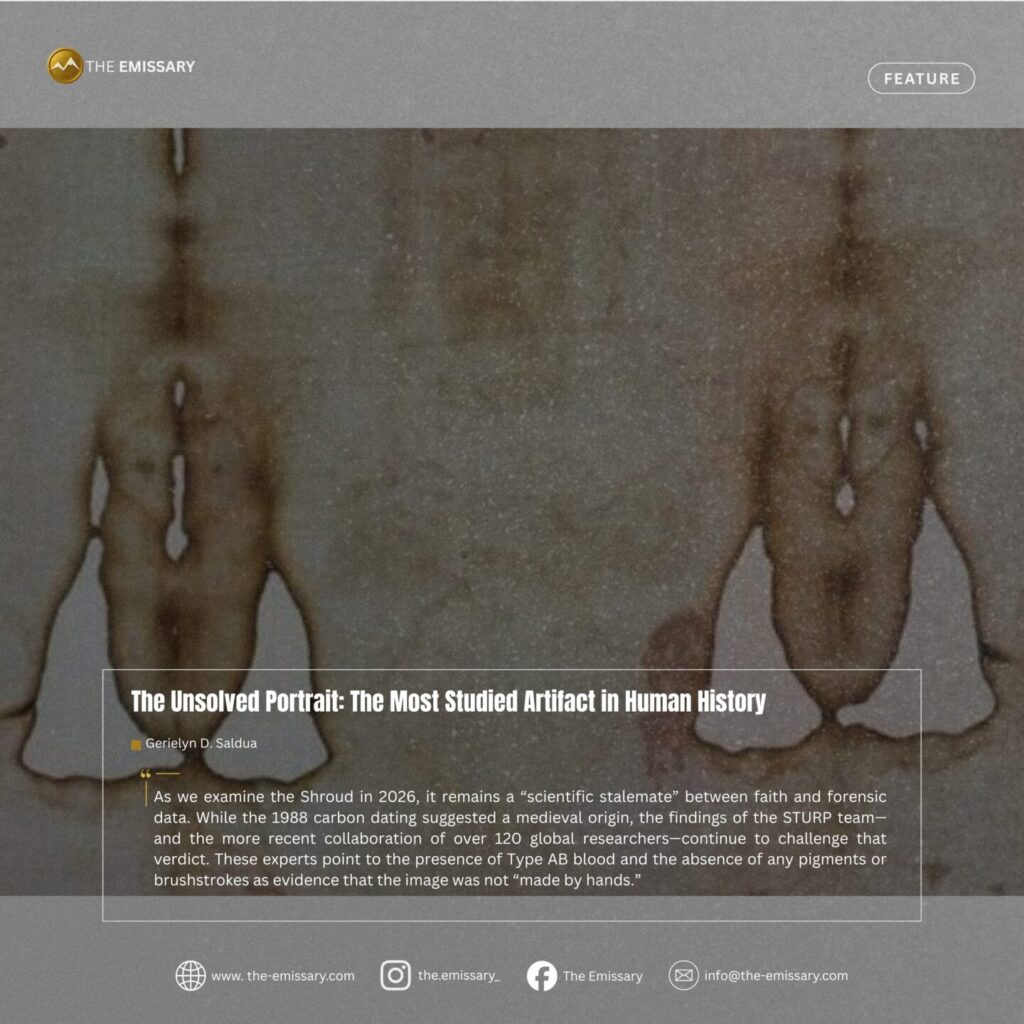
As we examine the Shroud in 2026, it remains a “scientific stalemate” between faith and forensic data. While the 1988 carbon dating suggested a medieval origin, the findings of the STURP team—and the more recent collaboration of over 120 global researchers—continue to challenge that verdict. These experts point to the presence of Type AB blood and the absence of any pigments or brushstrokes as evidence that the image was not “made by hands.”
Ultimately, whether the Shroud is the literal burial cloth of Jesus or a physical anomaly that science cannot yet explain, its power remains unchanged. As a “mirror of the Gospel,” it serves as a silent, bruised witness to the Passion.
References: