✍︎ Julia Marie Estrella
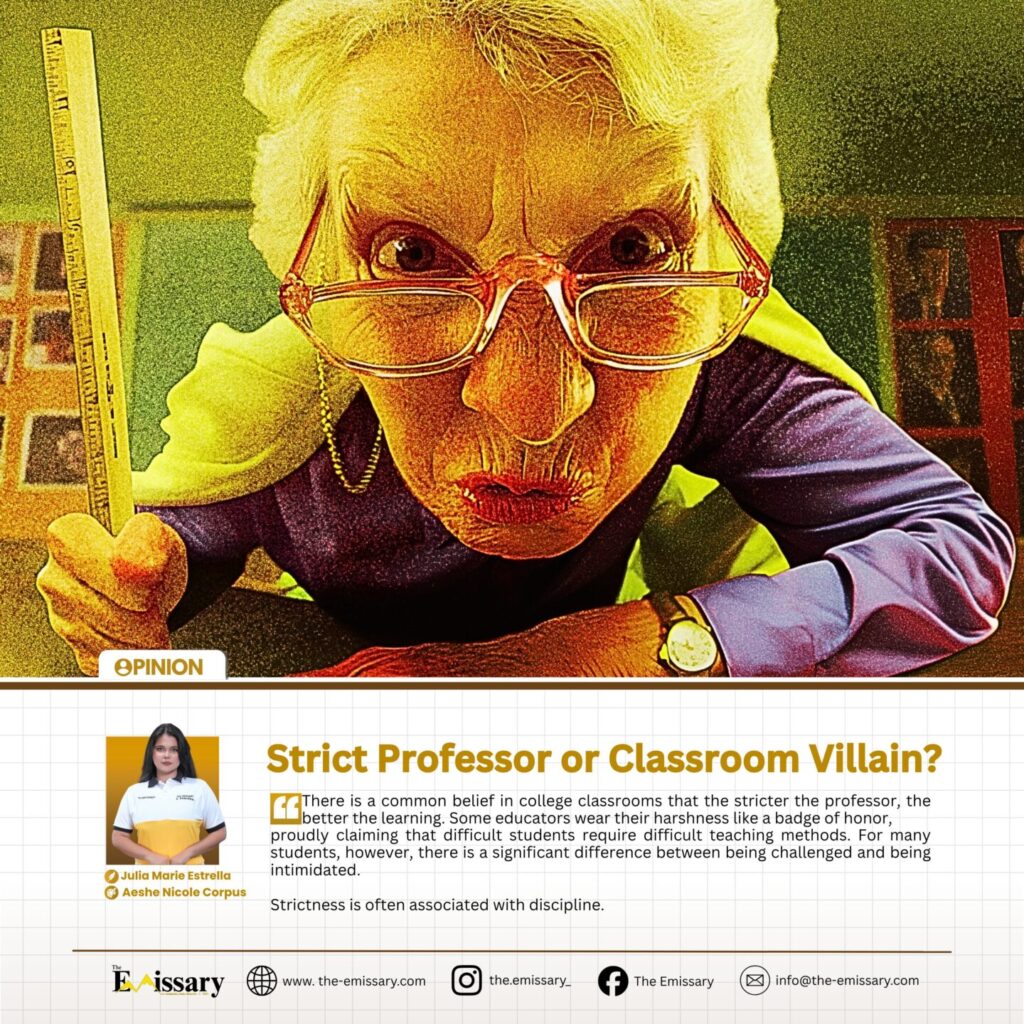
There is a common belief in college classrooms that the stricter the professor, the better the learning. Some educators wear their harshness like a badge of honor, proudly claiming that difficult students require difficult teaching methods. For many students, however, there is a significant difference between being challenged and being intimidated.
Strictness is often associated with discipline. Professors who enforce deadlines, maintain classroom order, and uphold academic standards play an important role in shaping responsible learners. The problem begins when strictness evolves into fear-based teaching. Instead of encouraging growth, some professors create environments where students are too afraid to ask questions, express opinions, or admit when they do not understand a lesson.
Many students have experienced classrooms where one wrong answer is met with public embarrassment, where simple mistakes become reasons for ridicule, and where speaking up feels more dangerous than remaining silent. In these situations, learning takes a back seat. Students focus less on understanding concepts and more on avoiding criticism.
Some professors justify this approach by arguing that the real world is unforgiving. They believe that pressure prepares students for future careers. While resilience is important, education should not be confused with endurance. A classroom is not a battlefield where students must survive humiliation to prove their worth. It is a space designed for learning, growth, and intellectual development.
Research and educational practice consistently show that students learn better when they feel psychologically safe. Confidence encourages participation, curiosity promotes deeper understanding, and constructive feedback helps students improve. Fear, on the other hand, often leads to disengagement, anxiety, and a reluctance to take academic risks.
The misconception that strictness automatically equals effectiveness may stem from outdated views of authority. In the past, professors were often expected to command respect through intimidation. Today, effective teaching is increasingly defined by the ability to inspire, communicate, and connect with learners while still maintaining high standards.
Being kind does not mean lowering expectations. Professors can be firm without being cruel. They can demand excellence while treating students with dignity. The most memorable educators are not always the toughest ones in the room. More often, they are the ones who challenged students to do better while making them believe they were capable of succeeding.
Perhaps the question students should ask is not whether a professor is strict enough, but whether their teaching actually helps students learn. After all, education should leave students with knowledge, not fear. And when fear becomes the lesson, something has already gone wrong.