✍︎ Julia Marie Estrella
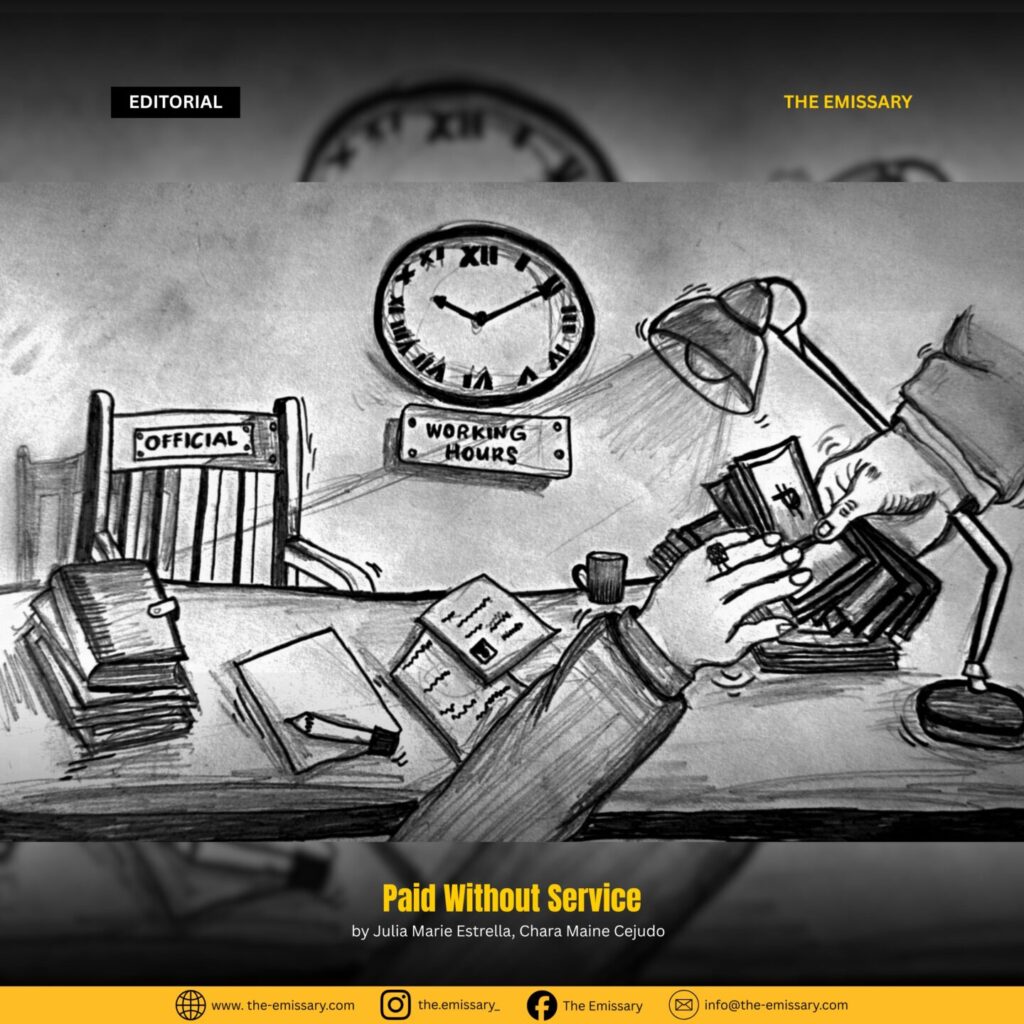
Public office is meant to serve the people, not exploit them. Yet, there remains a troubling reality in some institutions—officials who receive salaries despite failing to perform the work expected of them. This issue may not always be visible, but its impact is deeply felt. When those entrusted with responsibility neglect their duties while continuing to benefit from public funds, it becomes more than just inefficiency; it becomes a betrayal.
Every peso spent by the government comes from the people. It is taken from the daily wages of workers, the small earnings of business owners, and the limited resources of ordinary families. These contributions are given with the expectation that they will be used to improve services, build communities, and address the needs of society. When officials fail to fulfill their roles, they are not just wasting money—they are wasting the efforts and sacrifices of countless citizens.
The consequences of this neglect are far-reaching. Public services slow down, projects are delayed, and communities are left waiting for solutions that should have already been delivered. Behind every unfinished task or unattended concern are real people—students waiting for support, families needing assistance, and individuals depending on a system that is supposed to work for them. When responsibility is ignored, it is the public that suffers the most.
More concerning is the culture that this behavior creates. When a lack of accountability is tolerated, it sends a message that responsibility is optional and that one can benefit without contributing. This weakens the integrity of institutions and discourages those who genuinely want to serve with dedication. Over time, it creates an environment where effort is undervalued and complacency is accepted.
Addressing this issue requires more than simple awareness—it demands action. Stronger systems must be in place to ensure that officials are not only qualified but are also actively fulfilling their responsibilities. There should be clear standards of performance, regular evaluations, and appropriate consequences for those who fail to meet them. Transparency must be strengthened so that the public can see how resources are being used and who is accountable for delivering results.
However, accountability is not solely the responsibility of institutions. Citizens also have a role to play. By staying informed, asking questions, and demanding better governance, people can help ensure that public service remains true to its purpose. A government that serves well is one that is constantly being watched, challenged, and improved by its people.
At its core, this issue is about fairness and integrity. No one should benefit from resources they did not earn through honest work—especially in positions meant to serve the public. True service is not measured by titles or compensation, but by the willingness to fulfill one’s duty with sincerity and commitment.
Public office should never be a place where responsibility is optional. It is a duty that requires presence, effort, and accountability. Anything less is not just disappointing—it is unacceptable.
Illustration: Chara Maine Cejudo