✍︎ Caryl Jane R. Ordeñiza
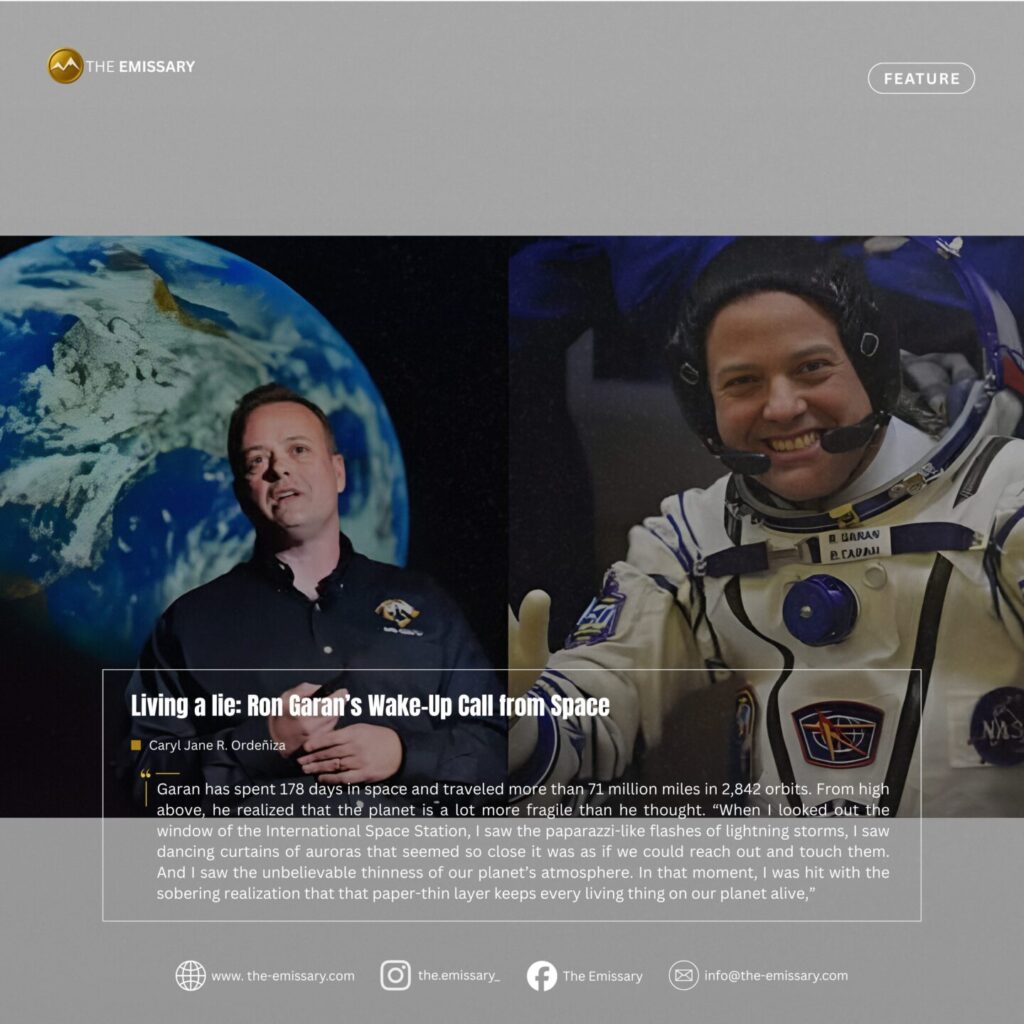
While living aboard the ISS, Ronald John Garan Jr. saw Earth from a view few people ever get to experience. Looking down at the planet changed the way he thought about life, humanity, and the choices people make on Earth.
Garan has spent 178 days in space and traveled more than 71 million miles in 2,842 orbits. From high above, he realized that the planet is a lot more fragile than he thought. “When I looked out the window of the International Space Station, I saw the paparazzi-like flashes of lightning storms, I saw dancing curtains of auroras that seemed so close it was as if we could reach out and touch them. And I saw the unbelievable thinness of our planet’s atmosphere. In that moment, I was hit with the sobering realization that that paper-thin layer keeps every living thing on our planet alive,” Garan said. Seeing this made Garan realize something very important— the earth is fragile and must be cared for.
While floating above Earth, Garan noticed something else. He could not see any borders between countries. He could not see any political divisions. He could not see money systems or economies. What he saw is a living planet. A world where everything and everyone is connected. And this caused a powerful change on how he thought about human priorities.
After returning to Earth, Garan said that “I saw an iridescent biosphere teeming with life. I didn’t see the economy. But since our human-made systems treat everything, including the very life-support systems of our planet, as the wholly owned subsidiary of the global economy, it’s obvious from the vantage point of space that we’re living a lie.” That the humanity is “living a lie.” He did not mean that the Earth is fake or that science is wrong. He meant that people often believe that the economy is the most important thing, when in reality the planet itself supports all life. From space, it became clear to him that nature is treated as less important than human-made systems, even though humans cannot survive without a healthy Earth.
This realization is part of what astronauts call the “overview effect”, a cognitive shift in awareness experienced when seeing Earth from orbit. NASA describes it as an experience that “shifts the way astronauts view and think about our planet and life itself.” From space, astronauts describe the planet as a glowing, fragile sphere, with no visible borders and a thin, delicate atmosphere. They often feel a deep connection to all life, a sense of responsibility, and the striking thought that every action on Earth matters.
Since returning to Earth, Garan has become an advocate for a “planetary perspective”, encouraging others not just to admire Earth’s beauty from afar, but to integrate this broadened worldview into how societies organize themselves. His message resonates beyond the space community that if humanity can internalize this wider perspective—where environmental health, social equity, and economic well-being are balanced in the order nature demands, then the “lie” he speaks of may be replaced with a more authentic and sustainable vision of life on Earth.
REFERENCES
Ron Garan — Space for Humanity. (n.d.). Space for Humanity. https://spaceforhumanity.org/about/team/ron-garan
Perry, T., & Staff, U. (2025, March 7). Astronaut explains the overview effect. Upworthy. https://www.upworthy.com/astronaut-shares-big-lie-space-ex1
Burke, O. (2024, July 11). How astronauts change in space as man who spent 178 days in space came to realise we’re “living a lie.” LADbible. https://www.ladbible.com/news/science/what-is-the-overview-effect-astronauts-nasa-ron-garan-098086-20240711