✍︎ Julia Marie Estrella
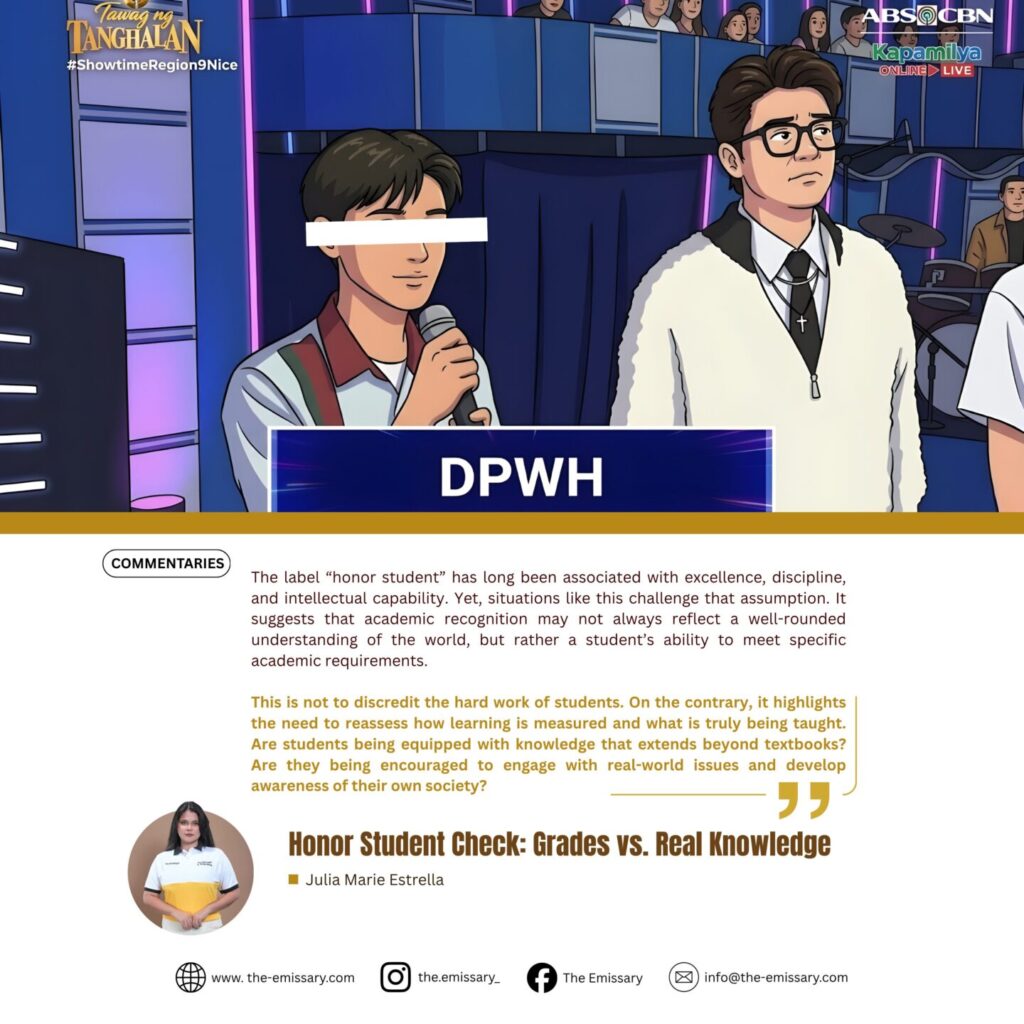
A recent segment from a noontime variety show sparked concern after several participants—identified as honor students from both junior and senior high school—struggled to answer basic questions about government agencies. While the moment quickly circulated online as entertainment, it raises a more serious and pressing issue: the current state of education.
At first glance, it may be easy to dismiss the incident as a simple case of pressure or nervousness. However, it also reveals a deeper concern about the kind of knowledge being prioritized in academic spaces. In an age where information is more accessible than ever, it is troubling to see gaps in what should be considered common, practical knowledge.
The label “honor student” has long been associated with excellence, discipline, and intellectual capability. Yet, situations like this challenge that assumption. It suggests that academic recognition may not always reflect a well-rounded understanding of the world, but rather a student’s ability to meet specific academic requirements.
This is not to discredit the hard work of students. On the contrary, it highlights the need to reassess how learning is measured and what is truly being taught. Are students being equipped with knowledge that extends beyond textbooks? Are they being encouraged to engage with real-world issues and develop awareness of their own society?
The responsibility does not fall solely on the students. It is shared by educators, institutions, and the system as a whole. If the goal of education is to prepare individuals for life beyond the classroom, then it must go beyond grades and honors. It must cultivate critical thinking, awareness, and meaningful understanding.
Ultimately, this moment should not serve as a source of ridicule, but as a wake-up call. Because the true measure of education is not found in titles, but in the ability to understand, question, and engage with the world.