✍︎ Xaviery Xinia Guinocor
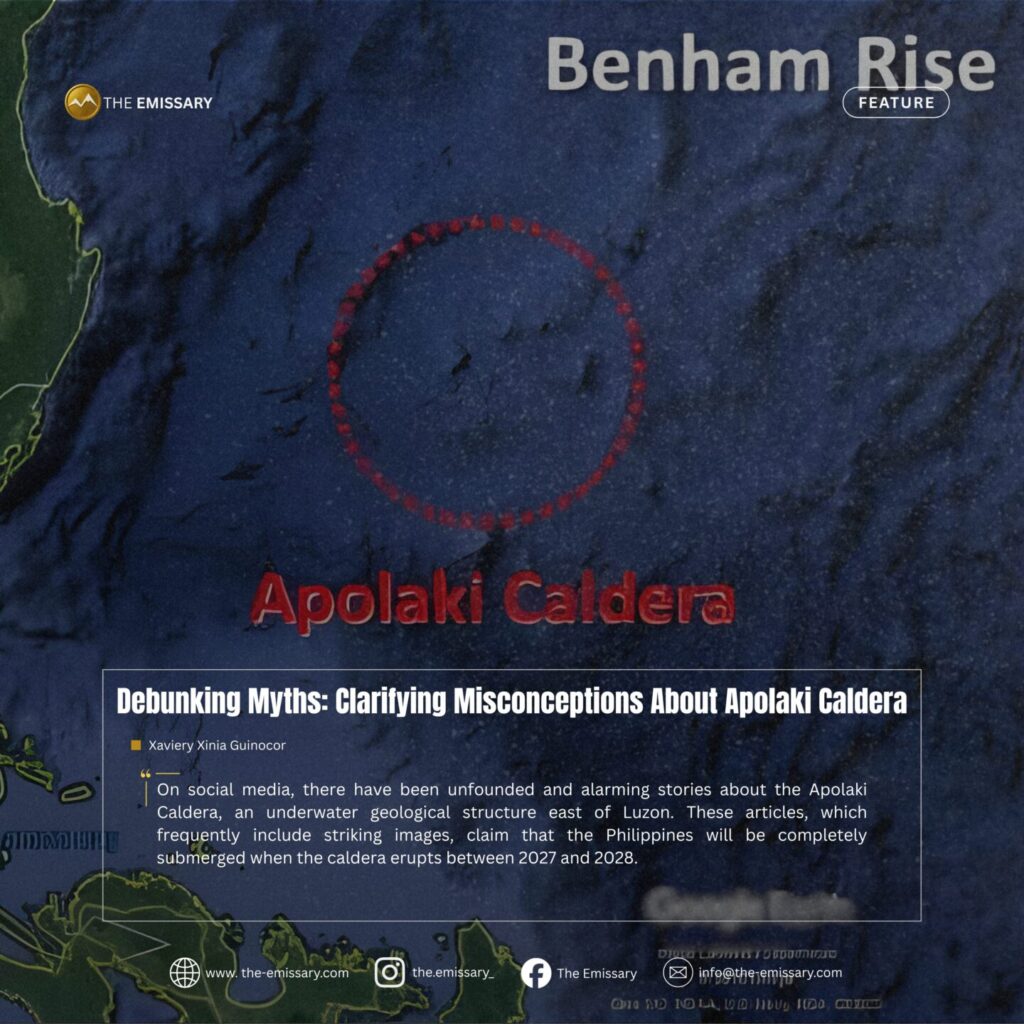
On social media, there have been unfounded and alarming stories about the Apolaki Caldera, an underwater geological structure east of Luzon. These articles, which frequently include striking images, claim that the Philippines will be completely submerged when the caldera erupts between 2027 and 2028.
According to Britannica, most calderas—large circular or oval depressions more than 1 km (0.6 mile) in diameter—have been formed by the inward collapse of landforms after large amounts of magma have been expelled from underground. Many are surrounded by steep cliffs, and some are filled with lakes. The terms crater and caldera are often used synonymously, but calderas are larger than craters. A crater can occur inside a caldera, as at Taal Lake in the Philippines, but not the reverse. Calderas are often associated with large eruptions (those producing volumes of 10 cubic km [2.4 cubic miles] or more) of dacitic or rhyolitic magma that form pyroclastic plateaus.
According to the research of GNS Science Te Pū Ao, the name Apolaki, chosen by Ms. Barretto, literally translates to “giant lord” in Filipino—indicating the large size of the caldera. Apolaki is so large that no comparison is available on Earth—during the review process, scientists had to draw on comparisons with calderas from Venus and Mars.
Is the Apolaki Caldera a cause for concern? And is it true that the Apolaki Caldera will explode in 2027 or 2028?
According to Republicasia, “Filipina geologist Jenny Anne Barretto, who is part of a team of marine geophysicists that discovered the existence of the Apolaki Caldera, dismissed claims that it could erupt in the coming years, stressing that it has been ‘extinct’ for millions of years.”
Now based in New Zealand, Barretto and two other scientists made their discovery about the Apolaki Caldera public through their research paper titled ‘Benham Rise Unveiled: Morphology and Structure of an Eocene Large Igneous Province in the West Philippine Basin.’
The 2019 study, which discussed the morphology and formation of the Philippine Rise, found that the Apolaki Caldera has a diameter of 150 kilometers (km), making it the world’s largest known caldera.
“The ‘world’s largest caldera’ is in the Philippine Rise, and there is no need to panic.” – Joanna Deala.
As Joanna Deala stated, “With all the recent disasters, including a string of earthquakes happening in the country, Filipinos could not help but feel scared and worried about their safety. Netizens are now using social media to raise awareness about the importance of preparing for disasters and emergencies that could happen. While doing so, some tend to share fearmongering posts or exaggerated information that only causes fear and anxiety among people without verifying the facts. Case in point: the viral artificial intelligence (AI)-generated photo of the Apolaki Caldera, considered to be ‘the world’s largest known caldera,’ found in the Philippine Rise (formerly Benham Rise), which is causing panic among netizens.”
This statement reminds the nation not to be easily fooled by what is seen on social media platforms without evidence and proof that validate the said photo.
In summary, the unsettling narratives spreading across social media about the Apolaki Caldera and the supposed submersion of the Philippines lack factual basis and stem from misinformation. While concern about natural disasters is natural, it’s vital to depend on confirmed data and reliable sources. Disseminating alarmist content can incite needless dread and worry. Ultimately, the frightening tales shared on social media concerning the Apolaki Caldera and the possible sinking of the Philippines are baseless and rooted in false information. Though it’s normal to feel uneasy when faced with natural disasters, it’s essential to depend on verified information and trustworthy sources. Sharing fear-inducing posts can create needless alarm and stress.
Resources:
https://www.gns.cri.nz/news/scientists-discover-what-might-be-the-worlds-largest-known-caldera/