✍︎ Julia Marie Estrella
In today’s digital world, anyone with a phone, a camera, and internet access can become a “news source” overnight. One viral video is enough to gain thousands of followers. One controversial opinion can attract millions of views. Because of this, many vloggers and influencers are now being treated as if they are part of the media frontline. But popularity online does not automatically make someone a journalist.
Clout is not journalism.
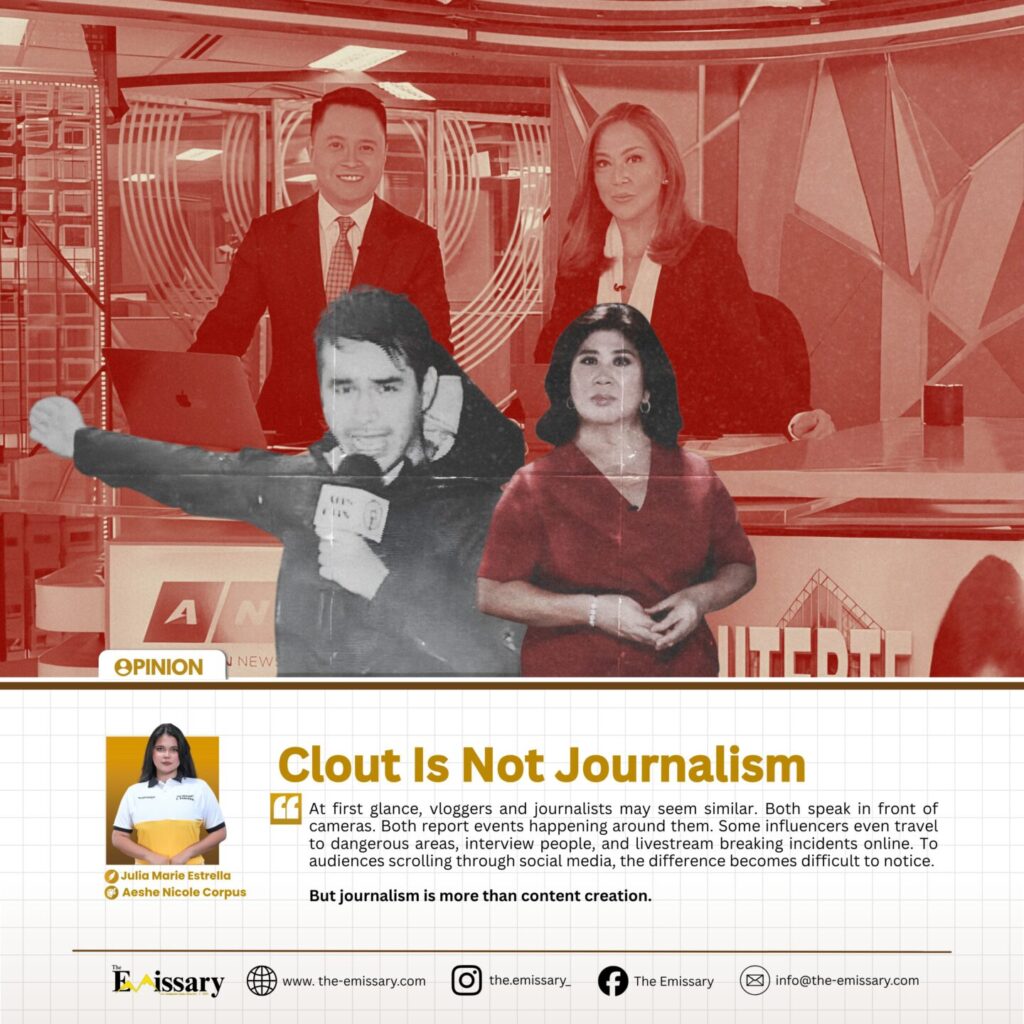
At first glance, vloggers and journalists may seem similar. Both speak in front of cameras. Both report events happening around them. Some influencers even travel to dangerous areas, interview people, and livestream breaking incidents online. To audiences scrolling through social media, the difference becomes difficult to notice.
But journalism is more than content creation.
Real journalism is built on truth, verification, and responsibility. Before a story is published, journalists are expected to fact-check information, confirm sources, and follow ethical standards. Their work undergoes editing, scrutiny, and public accountability because misinformation can affect real lives. Journalism exists not to entertain people, but to inform society responsibly.
Influencer culture works differently.
Most vloggers survive through engagement. Their income depends on clicks, reactions, shares, and views. In this environment, speed becomes more valuable than accuracy. The more emotional or controversial the content is, the faster it spreads. As a result, many creators exaggerate headlines, spread unverified claims, or turn serious issues into online entertainment simply to remain relevant.
Truth becomes secondary to virality.
This is where the danger begins. Social media has created a culture where influence is often mistaken for credibility. A person with millions of followers can easily shape public opinion even without evidence or journalistic training. Audiences now consume information based on personality rather than reliability. If the content is entertaining enough, many stop questioning whether it is even true.
Some vloggers present themselves as “the real frontline,” claiming they are more authentic than journalists because they are “raw” and “uncensored.” But being loud online does not make someone more truthful. Journalism is not measured by views, followers, or livestream numbers. It is measured by accountability.
Frontliners carry responsibility.
Journalists face criticism, pressure, harassment, and sometimes even threats to deliver verified information to the public. They are expected to remain careful with every report because one false statement can damage reputations, influence public opinion, or create panic. Their role is not simply to gain attention but to protect the integrity of information.
Many content creators, however, can easily move on once the trend dies. If false information spreads, accountability often disappears. Apologies become optional. Corrections are ignored. The cycle continues because outrage and controversy generate profit.
This growing confusion between journalism and content creation reflects a larger problem in society. People no longer consume news to understand issues deeply—they consume it for entertainment. Serious discussions are reduced into short clips, dramatic edits, and viral soundbites. Complex issues become simplified for engagement. In the process, truth loses value.
And when society values clout more than credibility, misinformation becomes stronger than facts.
This does not mean all vloggers are irresponsible. Some creators use their platforms wisely, raise awareness on important issues, and encourage meaningful discussions. But there is still a clear line between influencing people and practicing journalism. One is driven mainly by audience engagement; the other is bound by public responsibility.
A camera alone cannot make someone part of the frontline.
Because journalism is not about who uploads first. It is not about who becomes viral overnight. And it is certainly not about who gains the most followers online.
At its core, journalism is about protecting the truth even when the truth is inconvenient.
And no amount of clout can replace that.