✍︎ Caryl Jane R. Ordeñiza
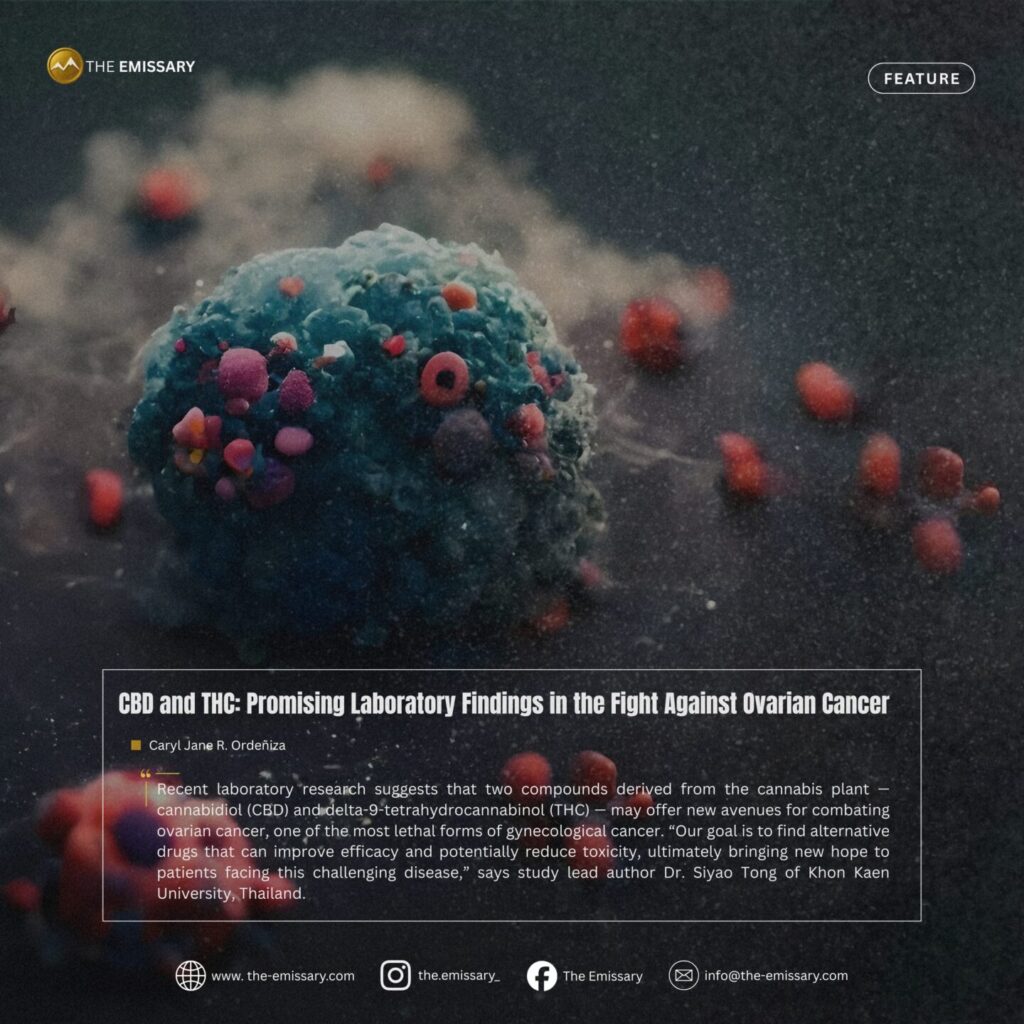
Recent laboratory research suggests that two compounds derived from the cannabis plant — cannabidiol (CBD) and delta-9-tetrahydrocannabinol (THC) — may offer new avenues for combating ovarian cancer, one of the most lethal forms of gynecological cancer. “Our goal is to find alternative drugs that can improve efficacy and potentially reduce toxicity, ultimately bringing new hope to patients facing this challenging disease,” says study lead author Dr. Siyao Tong of Khon Kaen University, Thailand.
In experiments conducted on ovarian cancer cells in the lab, scientists found that both CBD and THC can slow the growth of cancer cells and reduce their ability to form colonies. Notably, the combined use of the two compounds in a 1:1 ratio produced enhanced anti-cancer effects, with greater efficacy observed at lower dosages. This finding suggests that combining the two compounds may be more effective than either compound alone.
Ovarian cancer is notoriously difficult to treat because it is often diagnosed at advanced stages and frequently develops resistance to standard chemotherapy. According to researchers, this high mortality rate underscores the urgent need for novel treatment strategies that are both effective and less toxic than current therapies. In the laboratory study, the combination of CBD and THC not only slowed cancer cell growth but also reduced cancer cell migration — a key factor in the spread of the disease.
Importantly, the treatment resulted in minimal damage to healthy cells, indicating the potential for future therapies with improved patient tolerability.
Researchers also investigated the molecular mechanisms behind these anti-cancer effects. A new peer-reviewed study published in Frontiers in Pharmacology demonstrated that the CBD:THC combination treatment inhibited ovarian cancer cell growth by modulating cancer-related signaling pathways. Specifically, the study found that the equimolar combination of CBD and THC significantly reduced the phosphorylation of key proteins in the PI3K/AKT/mTOR pathway, while increasing activity of PTEN, a tumor suppressor that helps counteract cancer cell survival signaling. This dual effect suggests a mechanism by which the cannabis compounds disrupt cancer cell proliferation and survival.
While this research is still in its early stages — being preclinical and limited to laboratory models — it suggests that compounds from cannabis could one day be part of targeted cancer therapies. However, the researchers emphasize that these results have not yet been tested in animal models or human patients.
The study authors strongly recommend further research, including animal testing and clinical trials, before any cannabis-based therapies could be considered safe and effective for patients with ovarian cancer. This caution is important because what works in a laboratory dish does not always translate directly into real-world medical treatments.
Despite these limitations, the research lays important groundwork for future investigation. Dr. Siyao Tong and colleagues describe their findings as an important first step toward understanding how CBD and THC could be used therapeutically against ovarian cancer — potentially in combination with existing treatments or as part of multi-compound drug formulations.
While this research highlights the exciting potential of cannabis compounds in oncology, experts also note that cannabis is already used clinically primarily to manage symptoms related to cancer and chemotherapy — such as nausea, vomiting, pain, and anxiety — rather than to directly treat tumors. Clinical use in such symptomatic roles is supported by broader research outside this specific study.
Past studies in other cancer models show that cannabinoid receptors and endocannabinoid signaling can interact with cancer cell behavior, but clinical evidence for cancer-curing effects in humans remains limited.
Overall, the latest research indicates that CBD and THC — two of the most well-studied cannabis compounds — may act together to inhibit ovarian cancer cell growth and spread in laboratory models. Although this work is still in its early stages, it contributes to a growing body of scientific interest in cannabinoids as potential tools in the fight against cancer. Continued investigation, including well-designed clinical trials, will be essential to determine whether this promise can be realized in patient-focused treatments.
REFERENCES:
Tong, S., Loilome, W., Namwat, N., et al. (2025). Selective anti-cancer effects of cannabidiol and Δ9-tetrahydrocannabinol via PI3K/AKT/mTOR inhibition and PTEN restoration in ovarian cancer cells. Frontiers in Pharmacology. https://www.frontiersin.org/journals/pharmacology/articles/10.3389/fphar.2025.1693129/full
Technology Networks. (2025, December 17). Cannabis compounds show promise against ovarian cancer cells. Biopharma From Technology Networks. https://www.technologynetworks.com/biopharma/news/cannabis-compounds-show-promise-against-ovarian-cancer-cells-408045#:~:text=Now%20scientists%20looking%20for%20new,compounds%20kills%20existing%20cancer%20cells
Ferrer, B. (2025, December 17). Cannabis-based treatment with CBD and THC blend may fight ovarian cancer. Nutrition Insight. https://www.nutritioninsight.com/news/cannabis-marijuana-cbd-thc-ovarian-cancer.html
ScienceDaily. (2025, December 15). Cannabis compounds show unexpected power against ovarian cancer. https://www.sciencedaily.com/releases/2025/12/251215025315.htm
Healthline. (2025, December 15). CBD, THC may provide new ovarian cancer treatments, study finds. https://www.healthline.com/health-news/cannabis-cbd-thc-may-help-treat-ovarian-cancer-study