✍︎ Julia Marie Estrella
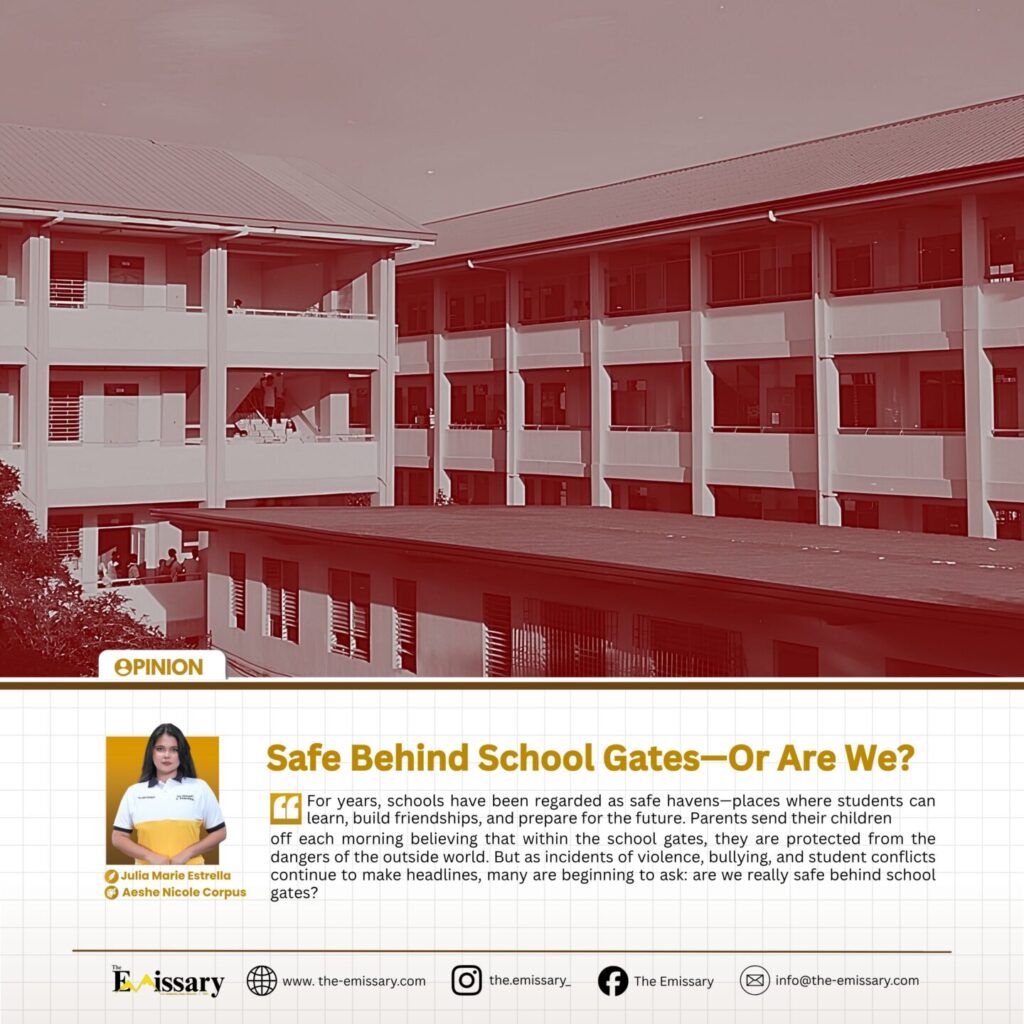
For years, schools have been regarded as safe havens—places where students can learn, build friendships, and prepare for the future. Parents send their children off each morning believing that within the school gates, they are protected from the dangers of the outside world. But as incidents of violence, bullying, and student conflicts continue to make headlines, many are beginning to ask: are we really safe behind school gates?
The image of school as a sanctuary has long been ingrained in society. It is where lessons are taught, talents are discovered, and dreams begin to take shape. Yet schools are not isolated from reality. The challenges that exist outside the campus often find their way into classrooms, corridors, and even online spaces where students interact every day.
Not all threats come from strangers. Sometimes, they come from the people students see daily. A classmate’s cruel remark, a rumor spread through social media, an act of exclusion, or a conflict left unresolved can create an environment where fear and anxiety quietly grow. While these situations may not always make headlines, their impact can be just as damaging.
Safety is often measured by visible security measures—guards at entrances, identification cards, CCTV cameras, and strict policies. These are important, but they do not tell the whole story. A school can be physically secure while students still feel unsafe emotionally and mentally. Fear does not always come from what is visible. Sometimes, it comes from the uncertainty of how others may treat us once we step into a classroom.
The question is no longer limited to whether schools can keep dangers out. It is also whether they can foster an environment where students feel respected, valued, and protected from harm within their own community. A truly safe school is not just one free from physical threats; it is one where students are free from intimidation, humiliation, and fear.
This responsibility does not rest solely on school administrators. Teachers, parents, and students themselves play vital roles in creating a culture of respect and understanding. Small acts of kindness, responsible communication, and the willingness to look out for one another can make a significant difference. After all, safety is not built by walls alone—it is built by people.
Schools should remain places where curiosity thrives, friendships flourish, and students feel secure enough to focus on learning rather than survival. But that reality can only exist when everyone actively works to preserve it.
So, are we truly safe behind school gates?
The answer depends not on the gates themselves, but on the community that stands behind them. Only when respect, empathy, and accountability become as important as academic achievement can schools genuinely be called safe spaces once again.