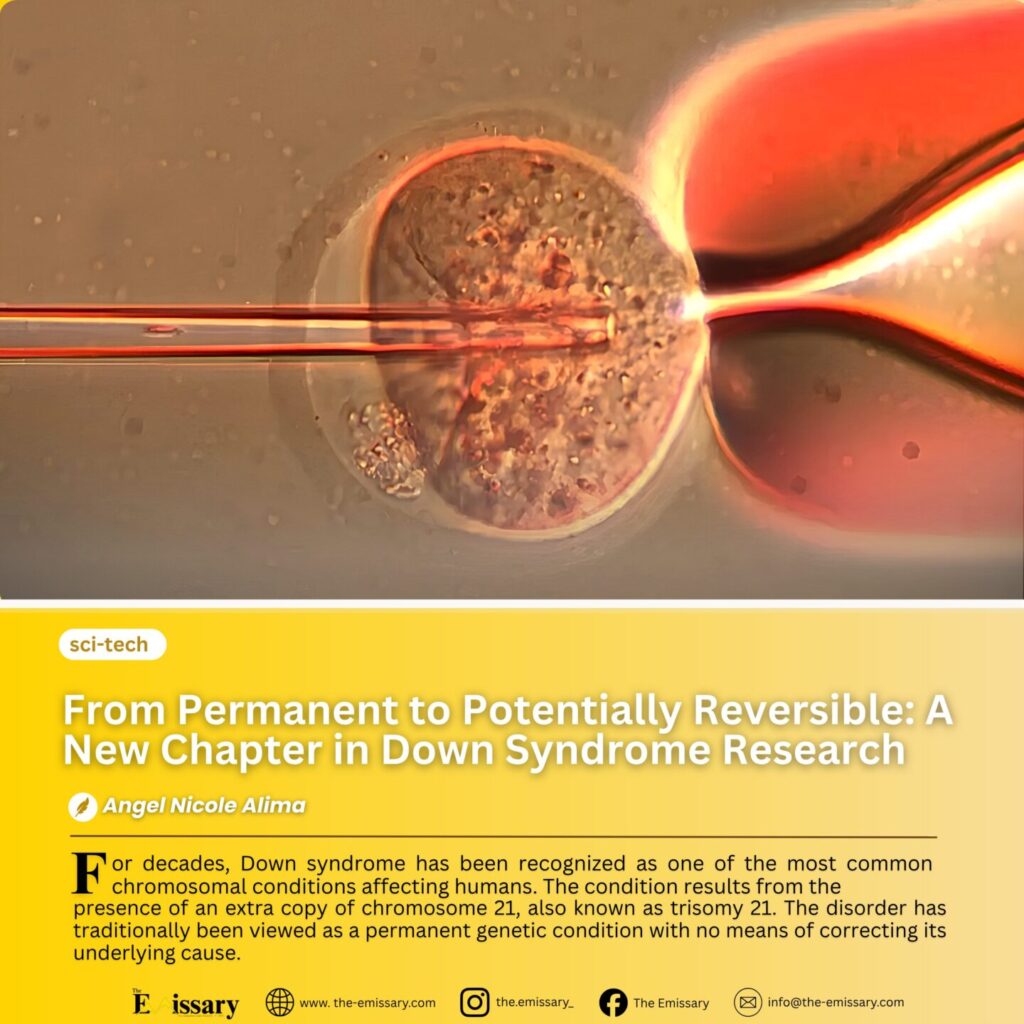
✍︎ Julia Marie Estrella
For decades, Down syndrome has been recognized as one of the most common chromosomal conditions affecting humans. The condition results from the presence of an extra copy of chromosome 21, also known as trisomy 21. The disorder has traditionally been viewed as a permanent genetic condition with no means of correcting its underlying cause. While advances in medicine have improved the quality of life and life expectancy of individuals with Down syndrome, treatments have primarily focused on managing symptoms rather than addressing the chromosomal abnormality itself.
Recent research, published in PNAS Nexus and led by Ryotaro Hashizume and colleagues, has demonstrated for the first time that CRISPR-Cas9 gene-editing technology can selectively remove the extra chromosome in human cells, opening up new possibilities for the treatment of chromosomal disorders.
The researchers tested this approach using induced pluripotent stem cells (iPSCs) and skin fibroblasts derived from individuals with Down syndrome. The technique involved introducing multiple targeted DNA breaks into the surplus chromosome, causing the cell to remove the unwanted chromosome during the repair process. As a result, several treated cells successfully returned to a normal chromosome count. More importantly, the corrected cells exhibited normalized gene expression patterns and cellular functions, indicating that the biological effects associated with trisomy 21 could be reversed at the cellular level.
Despite the excitement surrounding these findings, researchers caution that the work remains in its early stages. The experiments were conducted exclusively in laboratory-grown cells, and many challenges must be addressed before clinical applications become possible. Removing an entire chromosome within a living organism carries significant risks. Extensive research will be necessary to improve the safety, precision, and effectiveness of the technique before human trials can be considered.
The successful use of CRISPR-Cas9 to eliminate an extra chromosome demonstrates that such abnormalities may not be as permanent as once believed. Although practical treatments remain years away, this breakthrough offers hope for future strategies that could directly address the genetic origins of chromosomal disorders and transform the possibilities of modern medicine.
References:
PNAS Nexus. Trisomic Rescue via Allele-Specific Multiple Chromosome Cleavage Using CRISPR-Cas9 in Trisomy 21 Cells. February 2025.https://academic.oup.com/pnasnexus/article/4/2/pgaf022/8016019