✍︎ Maddy Delos Reyes
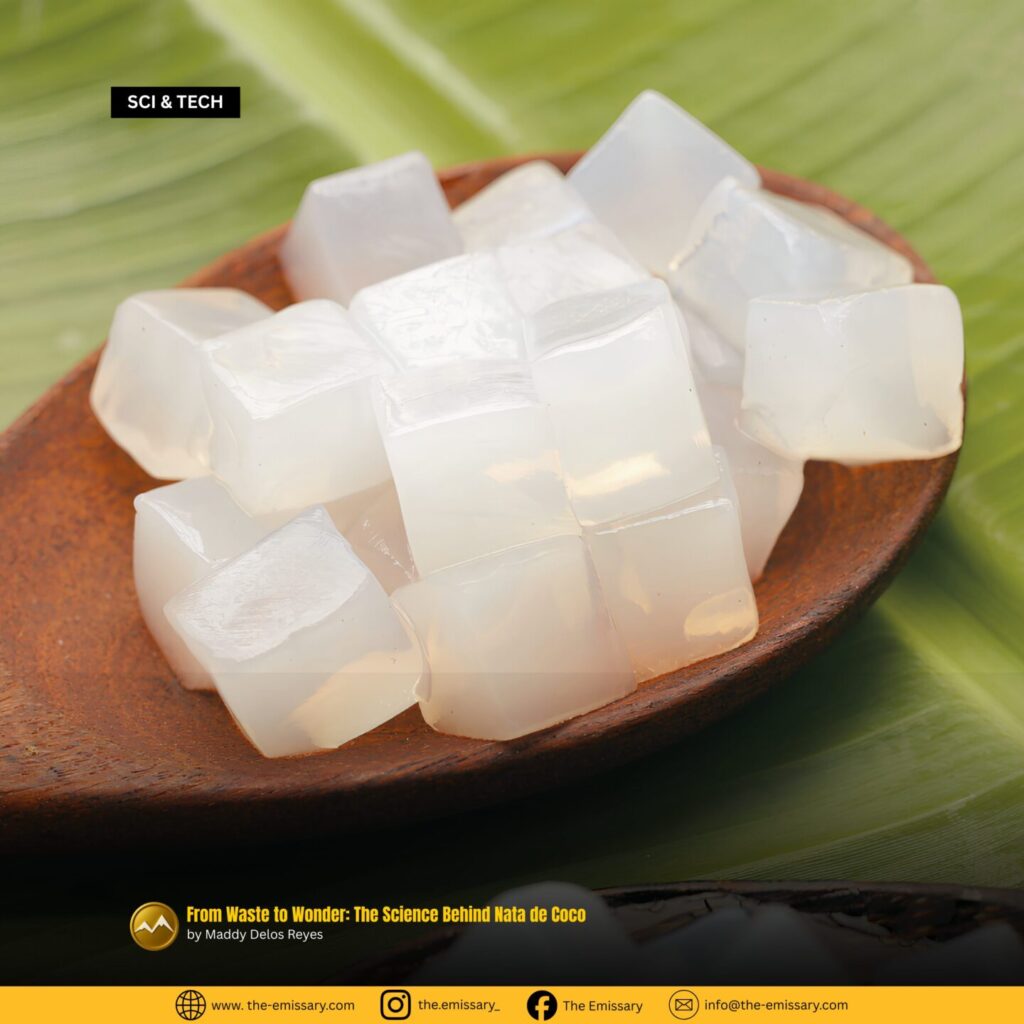
Step into any local dessert shop, and you are bound to see those familiar, clear, jelly-like cubes resting on top of a mountain of shaved ice in halo-halo. Nata de coco has become a favorite sweet treat for many Filipinos. Yet behind its fun, chewy texture lies a remarkable story of science and innovative waste management that transformed the Philippine coconut industry. What millions enjoy today as a dessert topping actually began as a clever solution to a massive agricultural waste problem.
For many years, the traditional coconut industry focused only on the white coconut meat. This left behind millions of liters of excess coconut water. Since it was considered useless waste, the liquid was routinely discarded by farms. It often ended up in nearby rivers, where it spoiled quickly, produced foul odors, and harmed aquatic life and plants.
In 1949, Filipino chemist Teodula Kalaw Africa chose to look at the problem differently. Working at the National Coconut Corporation, she did not see the leftover coconut water as garbage. Instead, she recognized it as a valuable resource for scientific innovation.
Africa discovered that coconut water, which is naturally rich in sugars and nutrients, could be transformed through fermentation. By introducing a safe bacterium called Acetobacter xylinum into the liquid, the microorganisms consumed the sugars and produced a thick, jelly-like layer of pure cellulose on the surface. After about two weeks, the layer became thick enough to be harvested, cleaned, cut into cubes, and cooked in sugar syrup to create the nata de coco enjoyed today.
One of the greatest strengths of Africa’s invention was its simplicity. The process did not require expensive machinery or advanced factories. Using only glass jars, clean cloth covers, and starter cultures, small communities could easily produce nata de coco themselves. Because of this, the innovation opened opportunities for farming families and women in rural areas to establish backyard businesses. Through science and creativity, a liquid once treated as waste became a profitable product recognized worldwide.
Today, nata de coco stands as a symbol of Filipino ingenuity—proof that science can transform everyday waste into something both delicious and beneficial for communities.
References:
https://www.batangashistory.date/2025/08/the-lipena-teodula-africa-inventor-of.html