✍︎ Angel Nicole Alima
The study of human evolution often begins with the story of early apes. These apes are believed to be the ancestors of modern apes and humans. For decades, East Africa has been considered the primary region where early apes evolved, mainly because many fossils have been discovered there. However, this long-standing idea is now being questioned due to newly discovered fossil evidence.
A team of scientists recently discovered a fossil jawbone in Wadi Moghra, Egypt. The fossil belongs to an early ape species called Masripithecus moghraensis, which lived around 17 to 18 million years ago. It includes part of a lower jaw and several teeth, which are important for identifying species and understanding their diet. According to researcher Shorouq Al-Ashqar, this discovery is significant because it suggests that scientists may have been focusing too much on a small part of the continent when studying early ape evolution. Their findings have opened a new window into how early apes spread across continents and diversified.
The fossil’s dental and jaw characteristics indicate that Masripithecus may have been closely related to the last common ancestor of all living apes, including humans. These findings not only expand our understanding of ape evolution but also challenge previous ideas about where these apes first diversified. The presence of such a species in northern Africa implies that early apes were spreading across different parts of the continent earlier than previously thought. According to Smithsonian Magazine, the fossil evidence suggests that ape evolution may have taken place in North Africa or even the Arabian Peninsula.
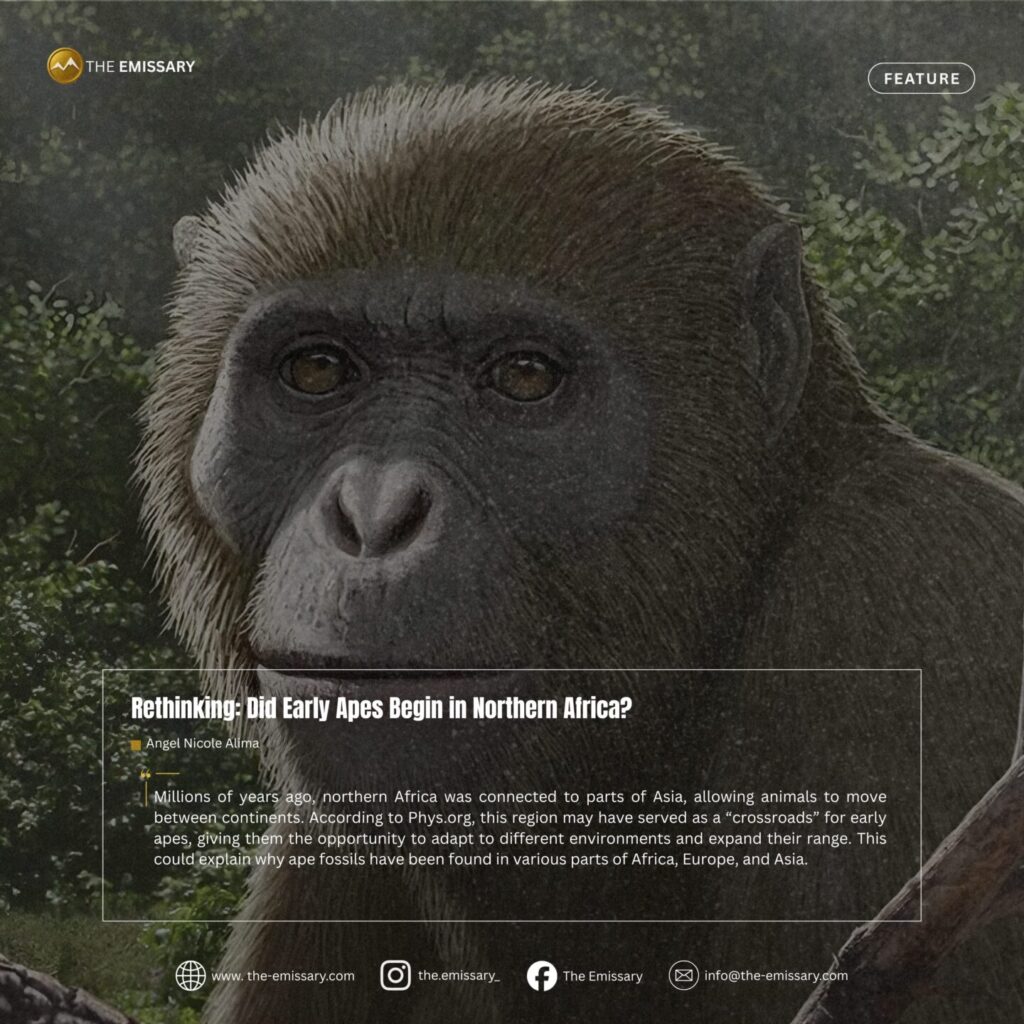
Millions of years ago, northern Africa was connected to parts of Asia, allowing animals to move between continents. According to Phys.org, this region may have served as a “crossroads” for early apes, giving them the opportunity to adapt to different environments and expand their range. This could explain why ape fossils have been found in various parts of Africa, Europe, and Asia.
The exact evolutionary significance of Masripithecus moghraensis remains unclear, but its discovery suggests that more ape fossils are yet to be found. As new evidence emerges, our understanding of ape and human evolution will continue to grow and evolve.
References
Science News. Early apes may not have evolved in East Africa. (March 26,2026) https://www.sciencenews.org/article/early-apes-not-evolved-east-africa
Live Science.18 million-year-old fossils of ape found in Africa, but in an unexpected place. (March 27,2026) https://www.livescience.com/archaeology/human-evolution/18-million-year-old-fossils-of-ape-found-in-africa-but-in-an-unexpected-place
Phys. Org. Masripithecus: A new Miocene ape from Egypt sheds light on the origins of modern apes. (March 26, 2026)https://phys.org/news/2026-03-masripithecus-miocene-ape-egypt-modern.html
Smithsonian magazine. These 17-Million-Year-Old Fossils Could Rewrite the Evolutionary Tree of Apes—Including Humans. (March 30, 2026)https://www.smithsonianmag.com/smart-news/these-17-million-year-old-fossils-could-rewrite-the-evolutionary-tree-of-apes-including-humans-180988446