✍︎ Xaviery Xinia Guinocor
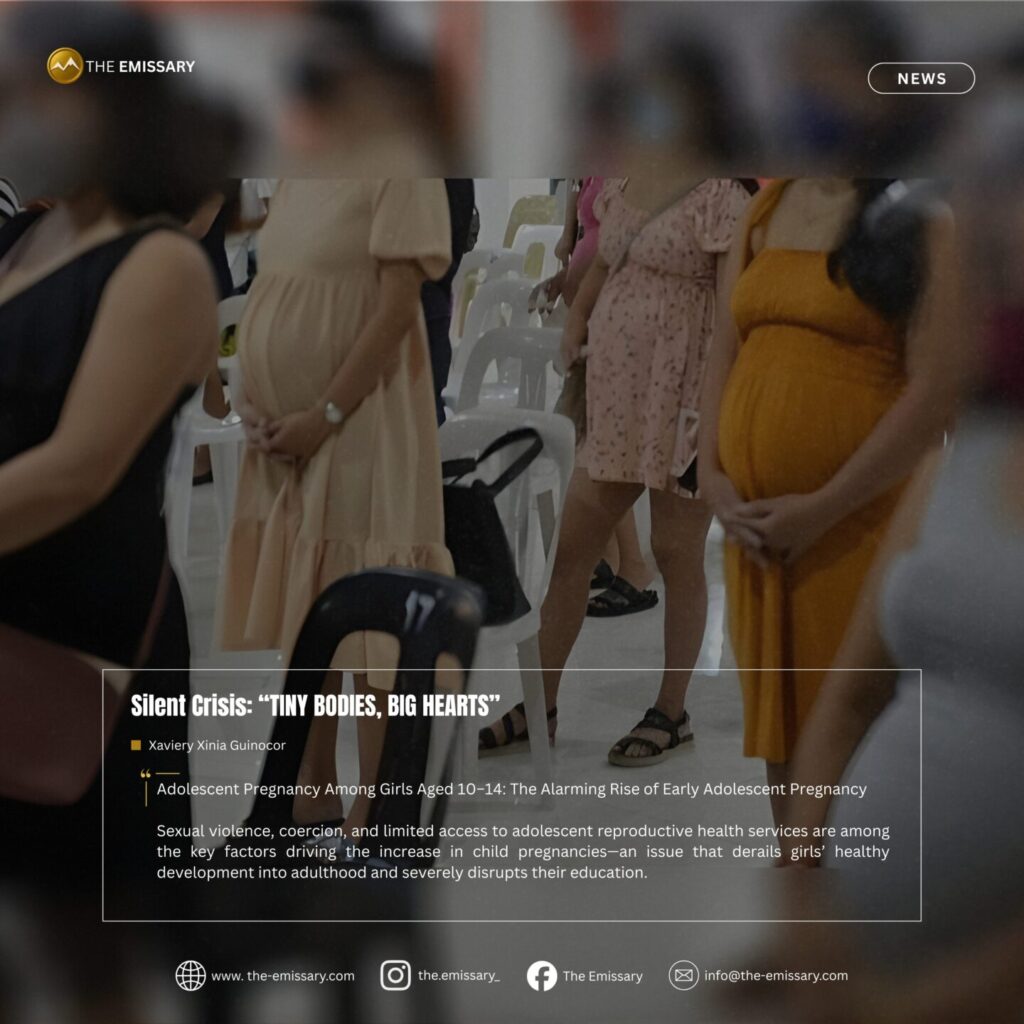
Adolescent Pregnancy Among Girls Aged 10–14: The Alarming Rise of Early Adolescent Pregnancy
Sexual violence, coercion, and limited access to adolescent reproductive health services are among the key factors driving the increase in child pregnancies—an issue that derails girls’ healthy development into adulthood and severely disrupts their education.
As of June 12, 2025, a 58% spike in pregnancies among girls aged 10 to 14 has intensified calls for legislation that would ensure teenagers have access to reproductive health services and comprehensive education, according to Save the Children.
Globally, adolescent pregnancy carries a significantly higher risk of maternal and infant mortality. It restricts girls’ opportunities to learn, as many pregnant adolescents are forced to drop out of school. Vulnerability to poverty, social exclusion, and dependency increases not only for young mothers but also for their children.
While there are instances in which adolescents wish to become pregnant, in many contexts around the world, early pregnancy is rooted in poverty, discrimination, and the lack of girls’ empowerment. It is often the result of gender-based violence, sexual abuse, coercion, or harmful traditional practices such as child marriage. In many countries and communities, children—especially girls—have little to no say over whom or when they marry.
In the Philippines, the Adolescent Pregnancy Prevention Bill, passed by the House of Representatives in 2023, was presented as a key solution to reducing the country’s high teenage pregnancy rate. The bill proposed the creation of the Adolescent Pregnancy Prevention Inter-Agency Council (APPIAC), tasked with formulating and implementing policies that provide family-oriented, adolescent-friendly sexual and reproductive health programs. These programs would focus on prevention, counseling, and post-delivery care, while expanding adolescents’ access to reproductive health services—including contraception—in a country where written parental consent is still required for individuals aged 18 and below.
However, opposition from conservative lobby groups led several Senate supporters to withdraw backing earlier this year, ahead of the national elections. With only one session remaining in the 19th Congress, the bill faces slim chances of deliberation before a new Congress convenes in July.
Sexual abuse, manipulation, and restricted access to reproductive health services remain the primary drivers of the rise in child pregnancies—an issue that compromises girls’ physical health, emotional well-being, and educational futures.
When Childhood Ends Too Soon
The increasing number of pregnancies among girls aged 10 to 14 in Western Visayas is more than a statistic—it is a painful reminder that many children are being forced to grow up far too soon.
Behind every number is a young girl whose childhood has been cut short, whose dreams have been interrupted, and whose future now carries burdens no child should ever have to bear. At an age when most children are focused on schoolwork, friendships, and play, some girls are already facing pregnancy, childbirth, and motherhood. This reality is deeply disturbing and demands more than quiet concern—it calls for honest reflection and collective action.
Early pregnancy poses serious risks, not only physically but also emotionally and socially. Young bodies are often unprepared for childbirth, increasing the danger for both mother and child. Equally damaging are the emotional scars—fear, confusion, shame, and isolation. Many of these girls are forced to leave school, closing doors to education and opportunity before they have a chance to begin.
The crisis also exposes critical gaps in systems meant to protect children. Many young girls lack access to age-appropriate education, guidance, and safe spaces where they can speak openly. Some are victims of abuse or coercion, while others grow up in environments shaped by poverty, silence, and stigma.
When society fails to listen and act, children bear the consequences. This issue does not belong solely to families or schools—it is a shared responsibility. Communities must move beyond blame and shame, which only push the problem further into the shadows. Instead, there must be a commitment to creating environments where children are informed, protected, and supported.
Parents need guidance to begin difficult conversations. Schools must strengthen values-based, age-appropriate education. Local leaders must ensure that health services are accessible, compassionate, and centered on children’s needs. Most importantly, these young girls must not be viewed as offenders, but as children in need of care and protection. Judgment only deepens their wounds and limits their chances to heal and grow.
The rise in pregnancies among 10- to 14-year-olds in Western Visayas should serve as a wake-up call. Childhood is not a privilege—it is a right. The response today will determine whether these children are defined by their circumstances or supported enough to rise beyond them.
REFERENCES
Philippines – Spike of 58% in child pregnancies should be a ‘wakeup call’ for better education and health services (2025). ReliefWeb.https://reliefweb.int/
Save the Children Resource Centre. (2024). “Only a Child, Already a Mother.”https://resourcecentre.savethechildren.net/
Reganit, J., & Cervantes, F. (2023, September 5). House approves bill preventing teenage pregnancies. Philippine News Agency.https://www.pna.gov.ph/